Great Horned Owl

Great Horned Owl DXO

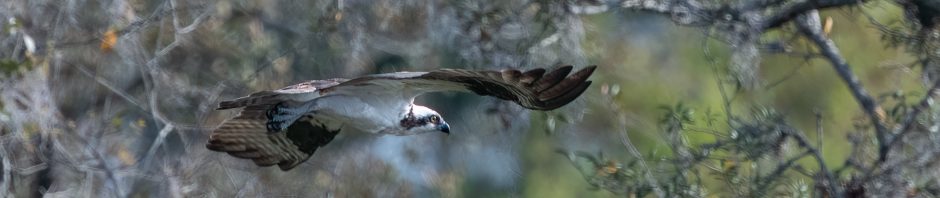
I normally wait until I have reviewed and processed all of my images from a photography outing before posting them to my website and blog, but I am so excited about seeing and being able to photograph a Great Horned Owl that I want to share it right away. The above Great Horned Owl was photographed at Paynes Prairie Preserve State Park, Gainesville, Florida, yesterday (December 15) at sunset.

When I arrived at Paynes Prairie, I heard the owl hooting in a heavily wooded area near the entrance to La Chua Trail. I have heard Great Horned Owls in that location many times during visits to the Prairie over the last few years, but have never been able to see or photograph them. I was hoping this visit would be different.

I was down the trail photographing wading birds in the setting sunlight, when the two Paynes Prairie volunteers, that were working the visitors trailer, came down the trail to tell me about the owl. I quickly shouldered my camera gear and hustled up the trail to where the owl was spotted. Unfortunately, it was far away and across the large sinkhole along the trail and perched on top of a very large dead tree. Although far away, its very small silhouette was unmistakeable as a Great Horned Owl.

I positioned and aimed my Nikon D800 with a Nikon 600mm lens and TC14 teleconverter, and using the manual mode, I began photographing the owl. I adjusted the camera’s settings a number of times as the light changed and tried to keep the ISO setting as low as possible while maintaining an appropriate shutter speed. Fortunately, the owl stayed on top of the tree, while I fired off a number of shots and only quit when it was too dark to get anymore images.

I will eventually process more images of the owl, as well as other images of sunrise and sunset on the Prairie and the other birds that I photographed. I expect to return to the Prairie, as well as other refuges and preserves over the next few weeks. In the meantime, I hope you have a wonderful holiday season.  Mine certainly has started out very well.

Posted in Bird Photographs, Nature | Tagged , | 8 Comments

American Bald Eagles at Conowingo Dam

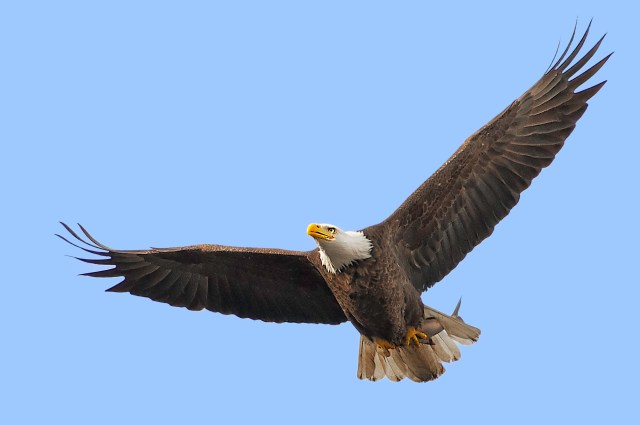
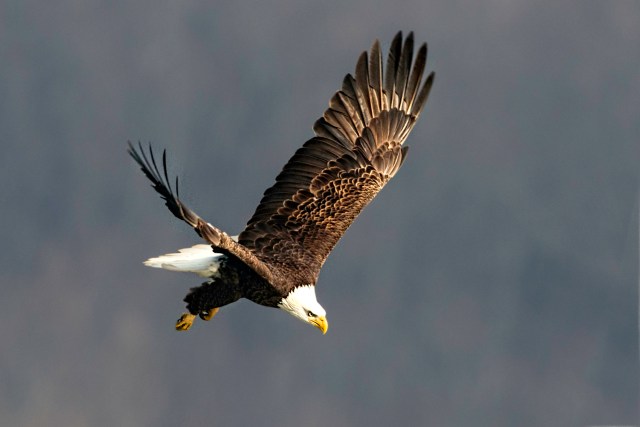
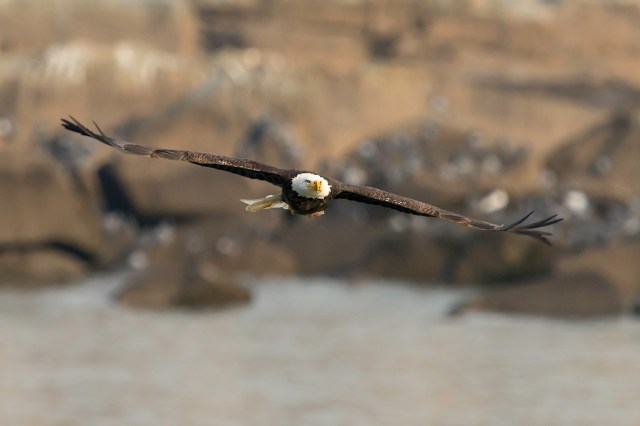
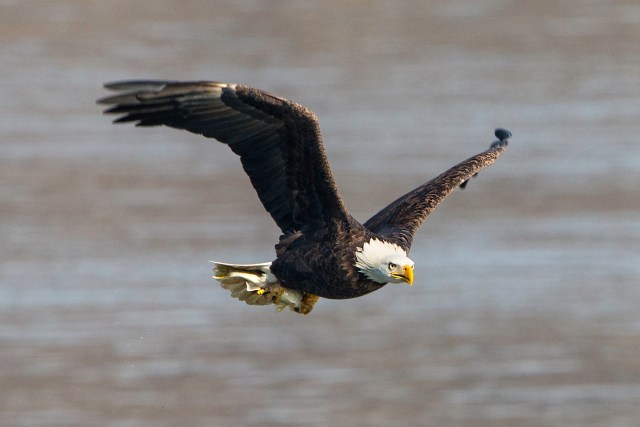
American Bald Eagle in Flight with Its Fish Catch

On November 29 and December 4, I went to the Conowingo Dam on the Susquehanna River in northern Maryland with a friend and fellow photographer to photograph the American Bald Eagles that spend the winter on the downside of the dam. The dam is about 100 miles from home, and to get there at sunrise, when the eagles are most active, requires leaving home very early. For me, one of the challenges to Nature photography is getting up in the middle of the night, but it is usually worthwhile and very rewarding getting to see and photograph wildlife, like the eagles in this article.

American Bald Eagles are opportunistic feeders, but their main diet is fish. Not all eagles migrate, but since fish is their preferred diet, those in the north migrate south in late fall when rivers, lakes and other waterways begin to freeze. That is why at times there can be over 100 eagles near the Conowingo Dam, because the downside of the dam generally does not freeze, and where when the dam opens to run its turbines, fish flow through the dam along with the water, and the stunned fish are easy pickings for the waiting eagles. The large number of eagles in this concentrated area make it one of the best, if not the best, locations to photograph American Bald Eagles along the east coast.

American Bald Eagle Flying over the Susquehanna River

The eagles are very active when the dam is open and the river is flowing through it. When the dam is closed, the eagle activity is very limited. Above, an eagle spotted a fish and began to dive toward the river. They swoop down, lower their legs when close to the water, open their talons, and when successful, grab a fish and take off with it under their tail.

American Bald Eagle Diving toward River

American Bald Eagle Catching a Fish

Not every attempt for a fish is successful, but in the above image, the eagle is taking off with its catch.

American Bald Eagle

American Bald Eagle Flying with Fish

After coming up from the river with its catch, the eagle flew in my direction (above and below images).

American Bald Eagle Flying with Fish

Most of the time, the eagles fly off to the other side of the river to eat their catch, but occasionally, they fly directly overhead toward the trees behind where I and other photographers are located.

American Bald Eagle Eating a Fish

Below an eagle is perched in a tree, watching other eagles and the river below.

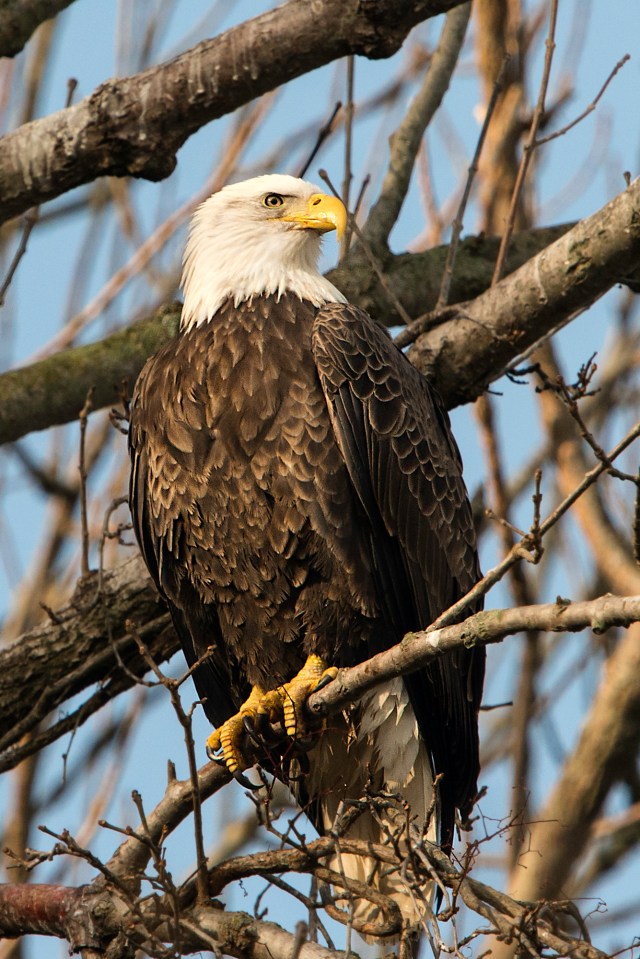
American Bald Eagle Perched in a Tree

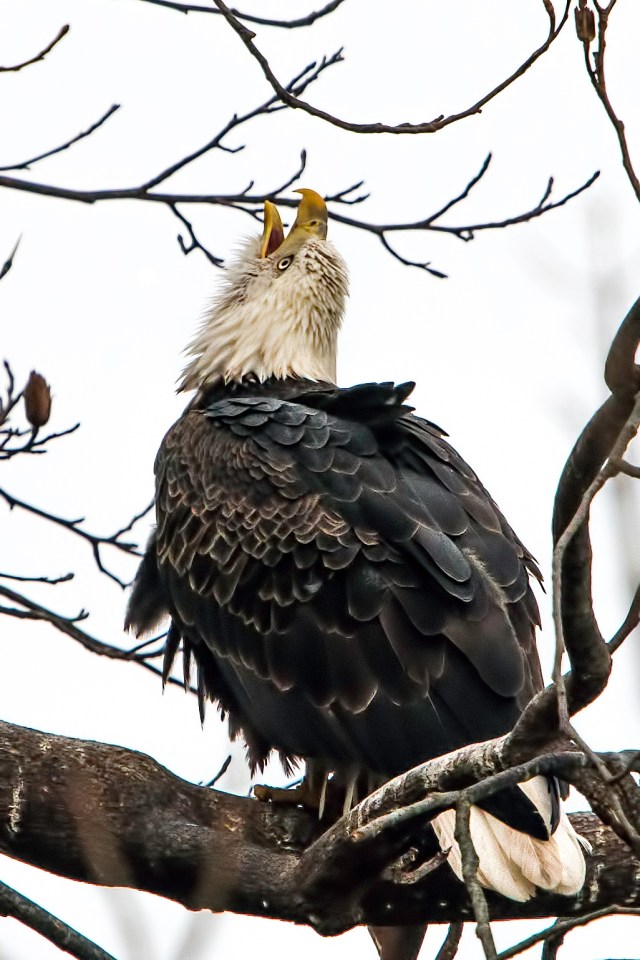
You probably have heard the term “screaming eagle.” At times, eagles do sound like they are screaming, which is very loud and used to communicate with other eagles. Below is an image of an eagle screaming.

Screaming Eagle

To see more of my eagle images, I posted an article in October that can be seen at https://stevetabone.wordpress.com/2012/10/13/american-bald-eagles-at-conowingo-dam/ or go to my website at: http://stabone.com/p922753828

Posted in Bird Photographs, Nature, Wildlife | Tagged , , | 14 Comments

A Fall Day at Leesylvania State Park, Virginia

This weekend, to get some fresh air, get out of the house, and maybe find something worth photographing, I went to my standby little piece of the natural world, Leesylvania State Park (LSP), in Prince William County, Virginia. It is within 5 miles of my home, and there is always something to see there any time of the year.

When I arrived at LSP, I drove through the park to see if there was anything unusual happening–and there wasn’t. I was not surprised, nor disappointed, because I knew I would eventually find something photo-worthy.

After parking, I went to Bushey Point with my Nikon D800 and 28-300mm lens, prepared for anything. I carried a small backpack with my 70-200mm (with a TC-20) and my 24-70mm, just in case. The first thing that caught my attention was all the fall colored leaves on the Bushey Point trail leading to the Potomac River. Although there was some green and fall colors left in the trees, there was no doubt that most of fall colored leaves were now on the ground (above image).

There was nothing special or unusual going on at Bushey Point, other than the Potomac River being lower than I had seen it all year. I was expecting to see the river’s shoreline covered in debris from hurricane Sandy and the river above its usual level, but the opposite was what I found. So, I thought I would experiment and photograph some of the colorful leaves on the ground with the intent of creating abstract images of the fallen leaves. I slowed my shutter speed down and with camera on a tripod, I took the first, above, and below images.

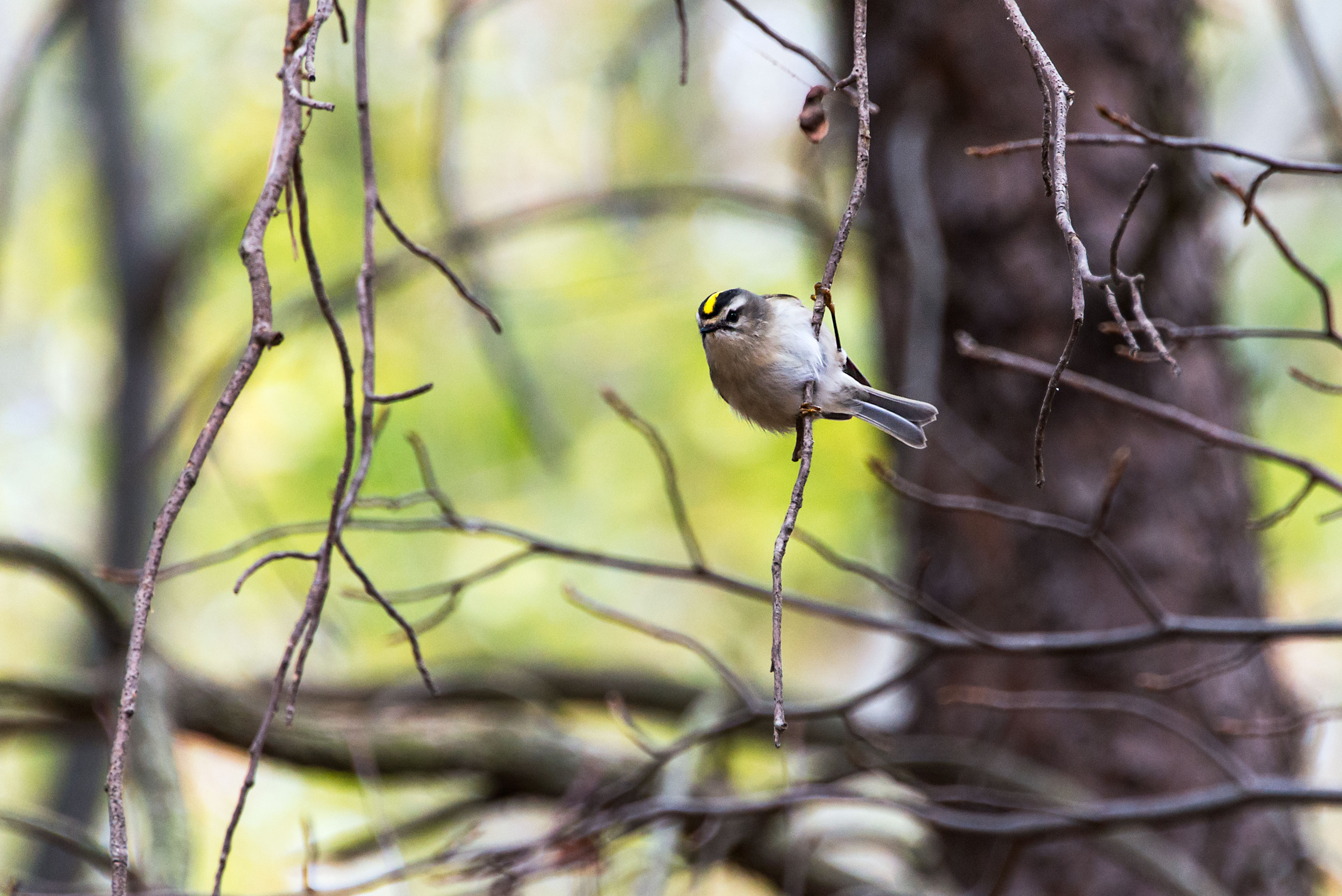
When I entered the boardwalk over a wetland, I met a friend, Judy, and during our conversation, she told me that she had just seen a Golden-crowned Kinglet and showed me the image of one on the back of her camera. The kinglet’s bright yellow striped head was very clear in the image. There was no doubt what it was. I hoped that I too would see one and be able to photograph it.

Shortly after leaving the boardwalk, I heard small birds high in the very tall trees. I could see a small bird darting from branch to branch, never sitting long in any one spot–not longer than a couple seconds. Each time it would land, I would quickly realign myself and camera, and occasionally get off a shot.

When the small bird came down from the tree tops and perched on a nearby branch, I was able to see it more clearly in my camera’s view finder, and it was a Golden-crowned Kinglet! And, it was checking me out. The kinglet was fast and kept flitting from branch to branch. Below is a shot of the kinglet just about to land on a branch.

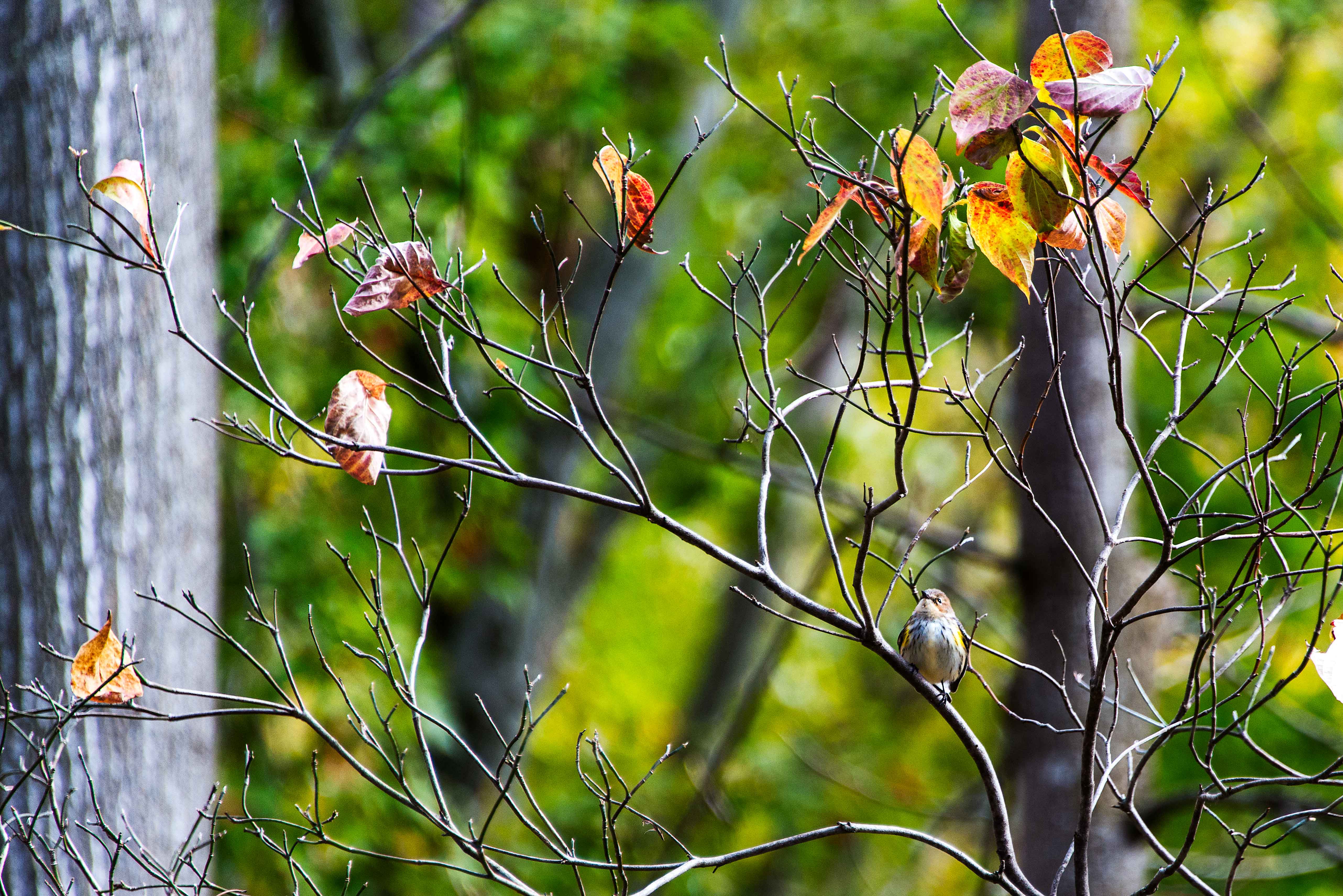
After the kinglet had enough of me, it took off, and it was shortly replaced by the bird in the below image. I believe it is a White-eyed Vireo, based on other images. It did not stick around long either.

As I was leaving Bushey Point, I noticed a deer in a nearby wooded area. As I took aim, I could see some nearby movement that turned out to be a pair fawns. They also took notice of me and quickly departed.

As mentioned when starting this article, there always seems to be something happening at LSP, my nearby little piece of the natural world, that is surrounded by sprawling suburbia.

Posted in Autumn Photography, Bird Photographs, Leesylvania State park, Nature, Wildlife | 10 Comments

Canaan Valley, West Virginia

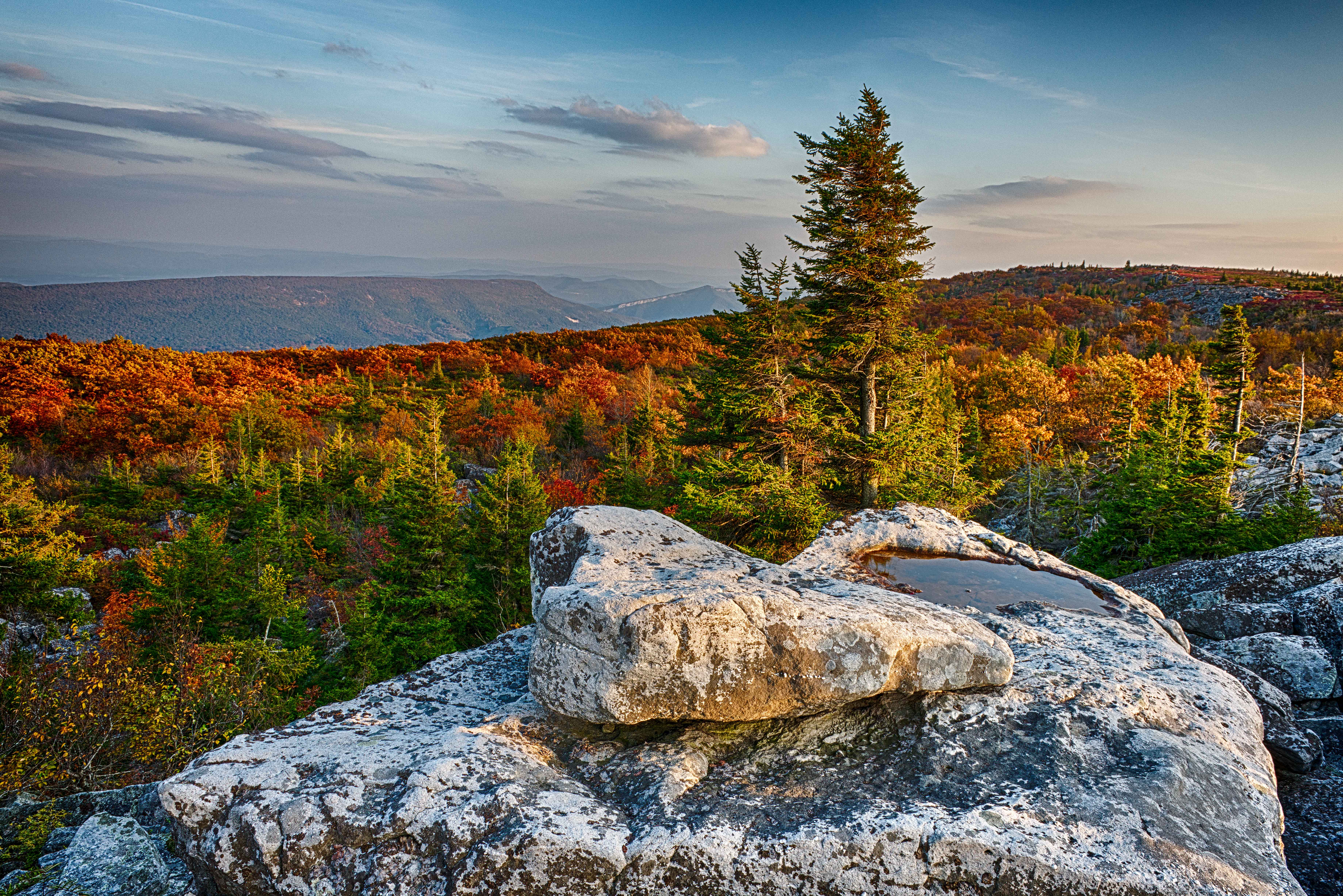
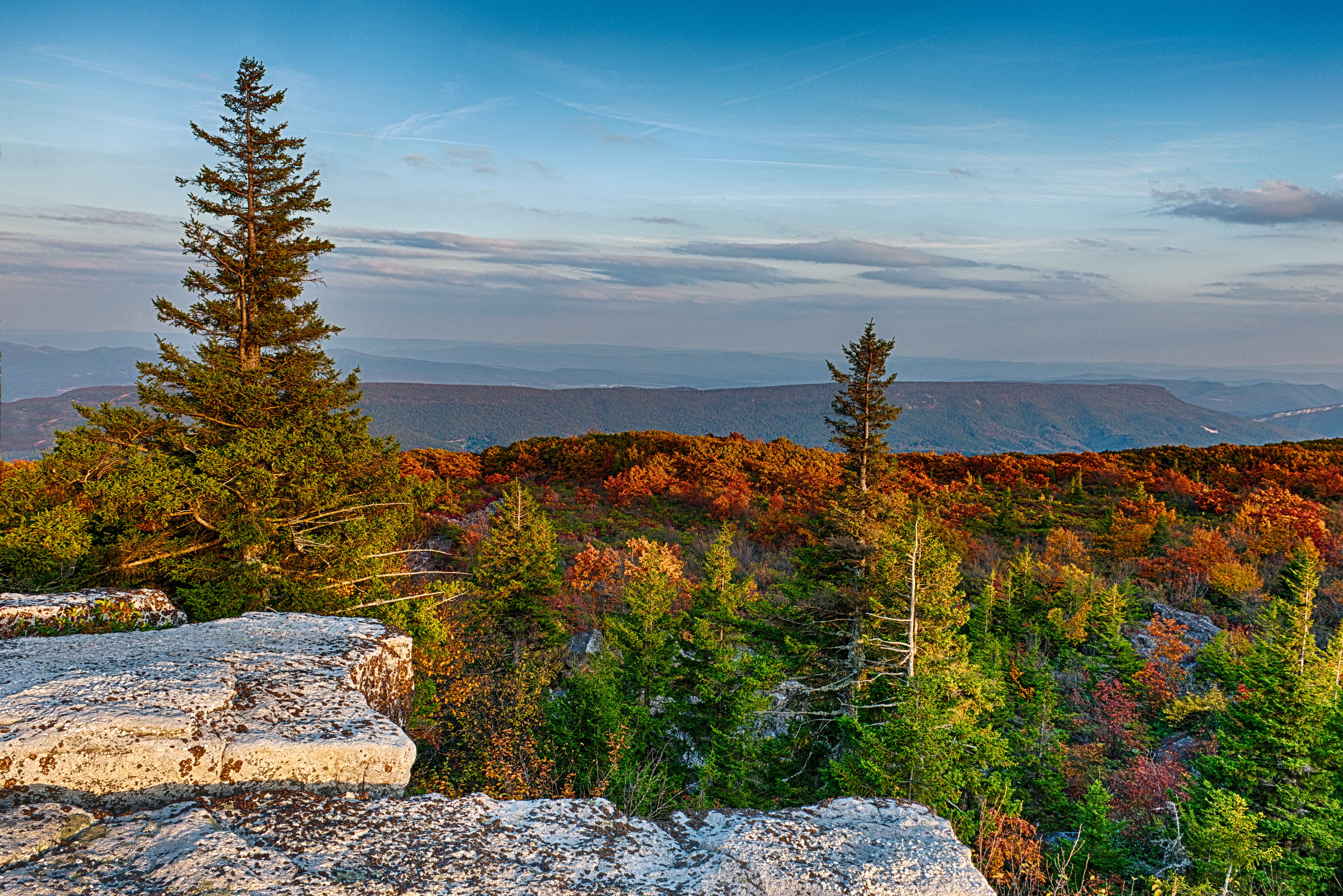
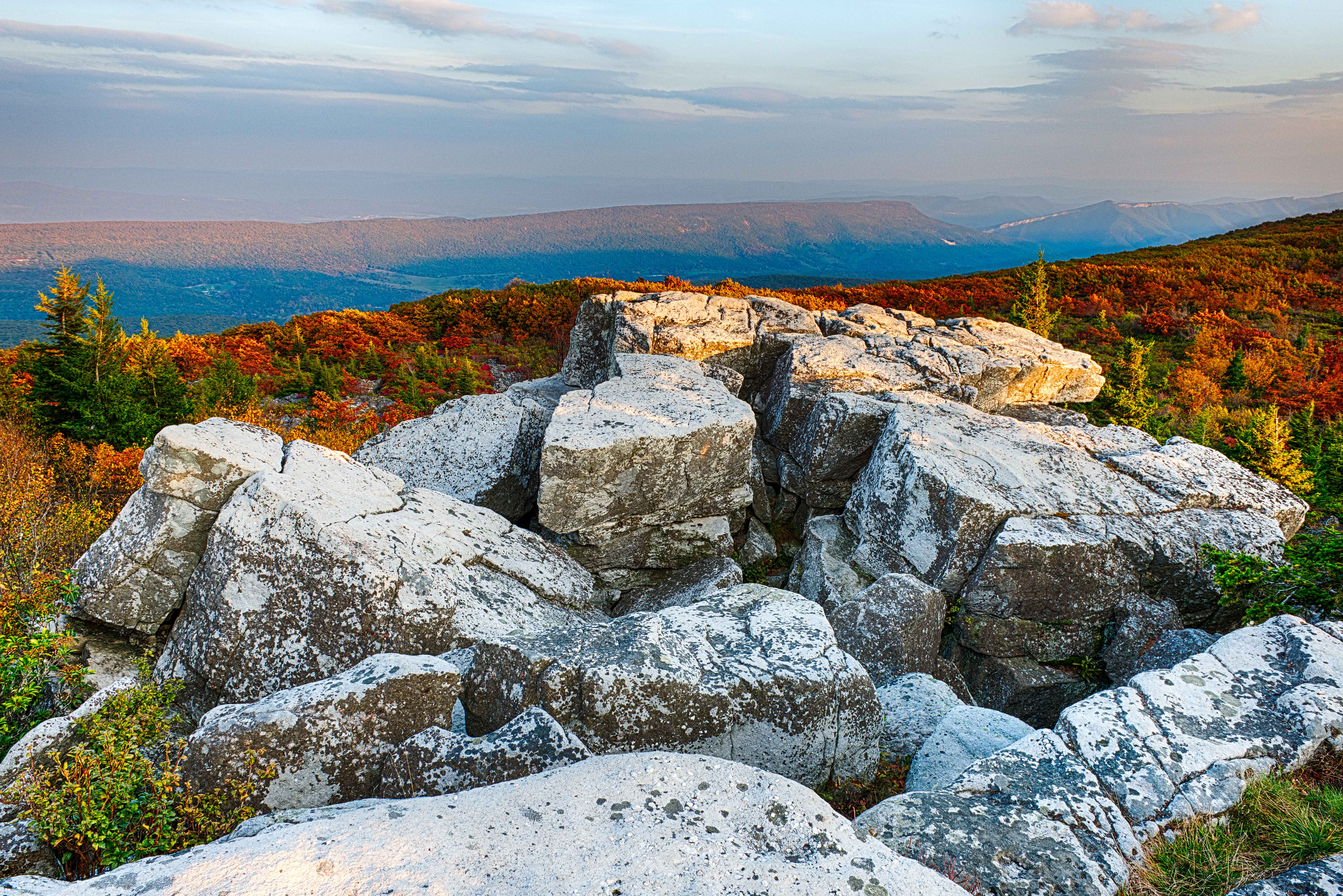
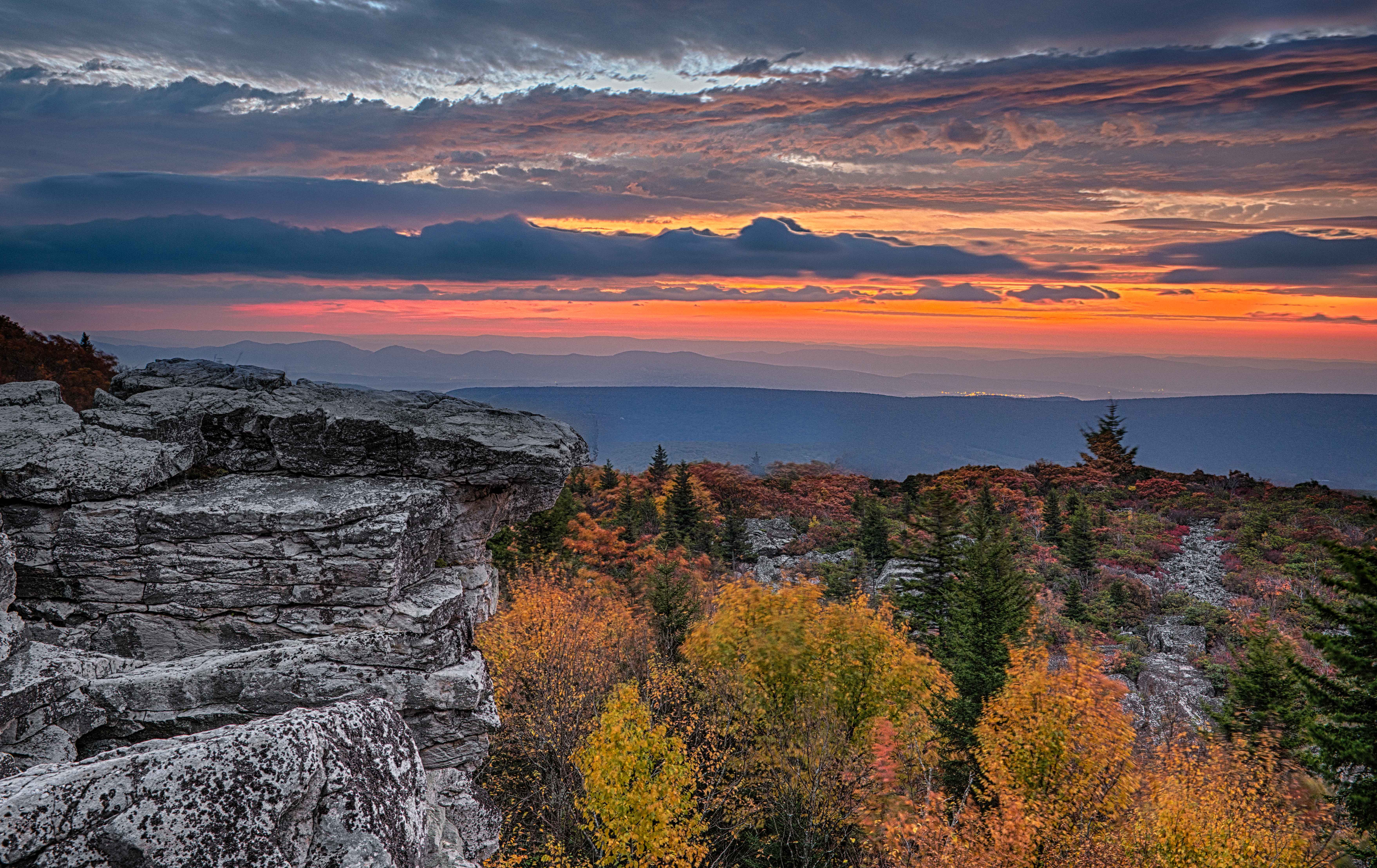
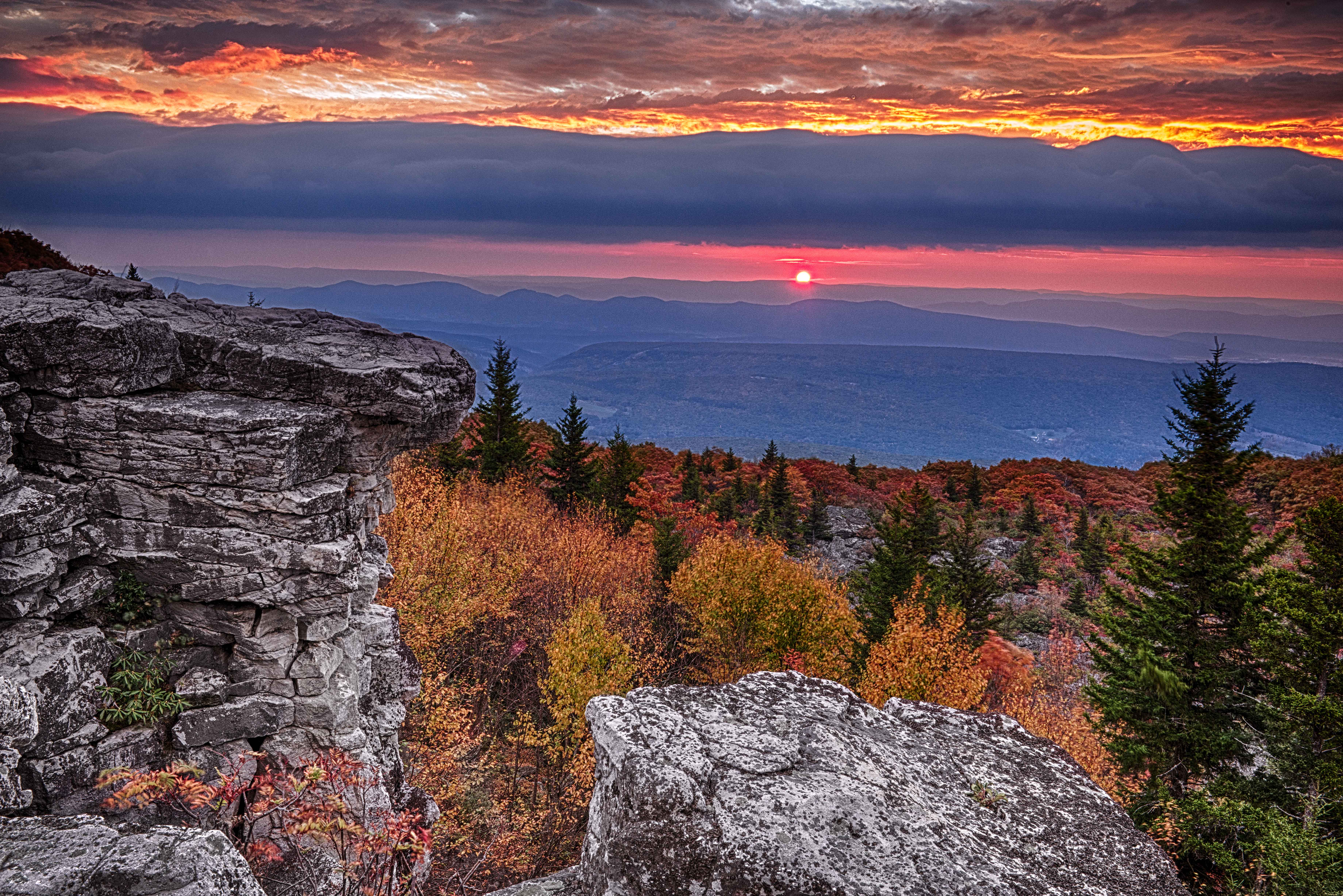
Three weeks ago, I spent a long weekend (Friday – Monday) in Canaan Valley, West Virginia, with two friends, who also are avid photographers. After about a 4 hour drive from northern Virginia, through area after area of peaked fall colors, we arrived in time to register the RV, set it up, and get to the top of Dolly Sods for sunset. As you can see from the above and following images, our timing was perfect to capture the late afternoon sunlight illuminating the Dolly Sods Wilderness plateau and surrounding areas.

Dolly Sods is a rocky, high-altitude plateau, ranging from 2,700 to over 4,00o feet. It is located in  in the Allegheny Mountains of eastern West Virginia in the Monongahela National Forest. Dolly Sods Wilderness encompasses 17,371 acres within over 32,000 acres of forest. When on the highest elevations of the plateau, there are wide sweeping views of the mountains to the east. The views are breathtaking and sunrises can be spectacular, depending on the weather and cloud cover.

Dolly Sods also has unusual landscapes. The landscape of the plateau is typically found in Canada with stunted red spruce trees, wind carved boulders and cliffs, heath barrens, and grassy meadows from years of logging and fires. Considering the devastating history of the area, the beauty is even more amazing.

There was enough time to shoot east to capture the sun lighting up the fall colored trees and mountain ridge lines, before turning toward the setting sun.

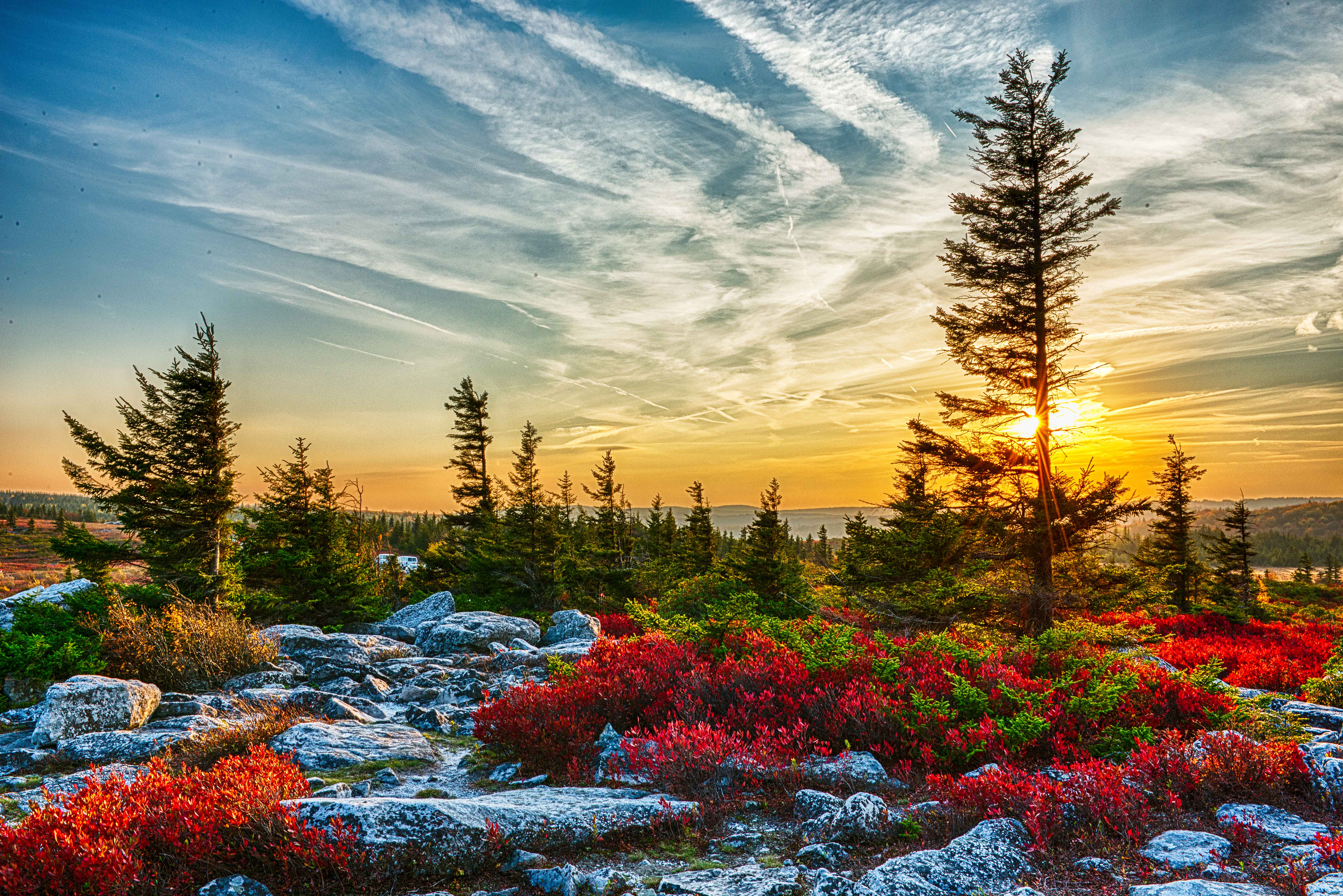
The sunset was spectacular. Unfortunately, Dolly Sods must be directly under the flight path for aircraft from the DC area heading west, because there were contrails everywhere in the sky.

When the sun gets close to the horizon (one or two sun-widths), it sinks quickly, requiring attaining the right location within a couple minutes of sunset. I hurriedly worked my way through a heath barren of waist to shoulder-high huckleberry, rhododendron, and cranberry plants to get to a location that would be composed of some of the plants, trees, and of course, the setting sun. It turned out to be a good location. The sunset was incredible.

The next morning, we were on Bear Rocks on Dolly Sods plateau before sunrise. Bear Rocks is located on the eastern edge of the plateau, overlooking the Shenandoah Valley, and the Shenandoah Mountains in the distance. The wind was blowing and gusting around 30 mph (guestimate), and it was in the 40s (another questimate), but watching the horizon begin to glow and seeing the sun quickly rise and disappear in the colorful clouds was worth the challenge of getting and being there–I do not have the words to do it justice. The below images captured some of the beauty.

As you can see, views from Dolly Sods are spectacular, but they also can easily be very different, with a thick cloud cover and rain.  That is how our next visit was, heavily overcast/cloudy, and raining on and off. Nevertheless, it still looked amazing, but it was either wet or not well lit. I still enjoyed being there. Below is a panoramic image comprised of 7 images taken from a rock outcropping and looking east toward the Shenandoah Valley.

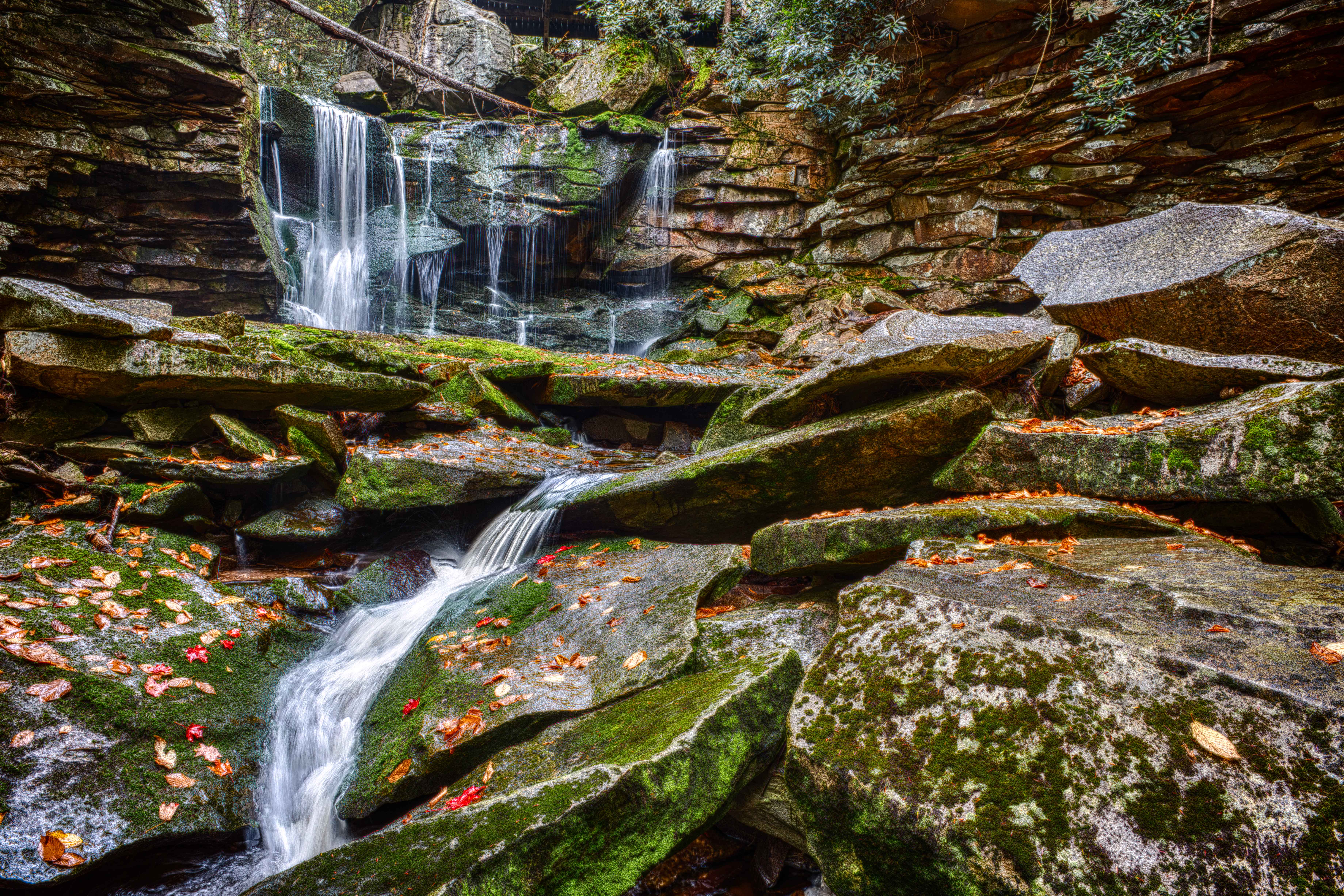
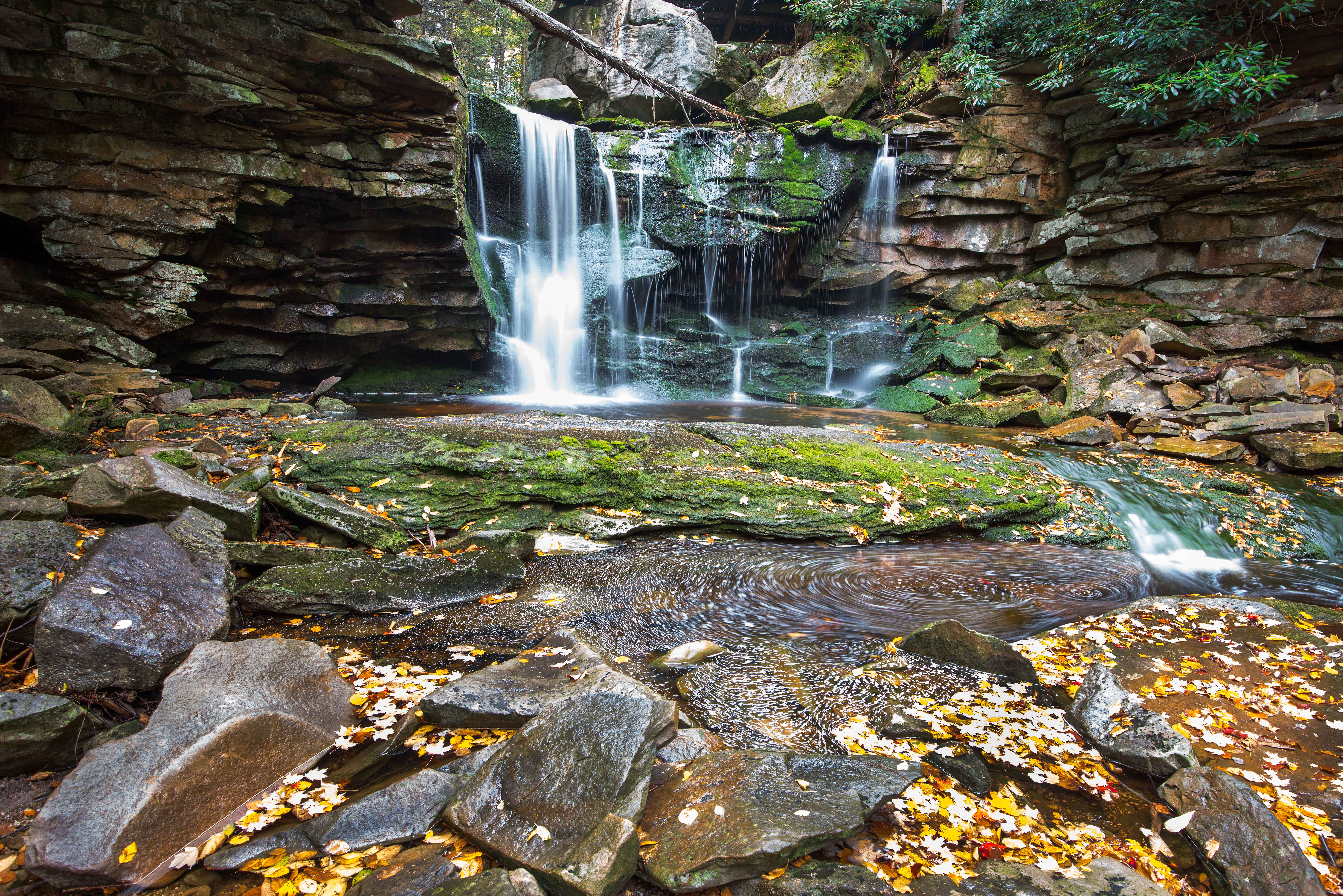
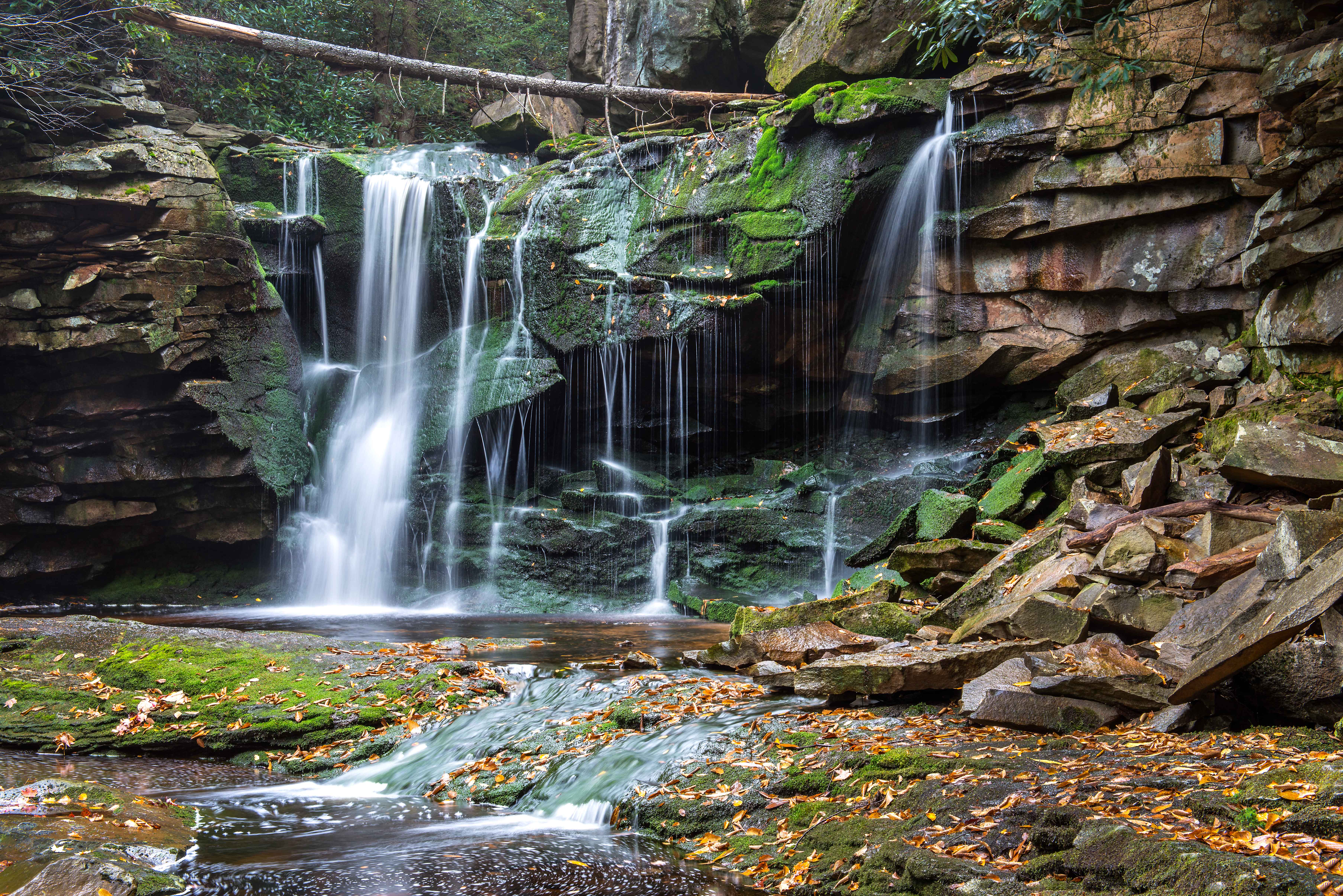
The next morning, we went to Elekala Falls. The weather was perfect for shooting the falls, overcast and occasional light rain. I was wearing knee-high boots and able to walk through the water to shoot the falls from many angles. Elekala Falls are beautiful, with its high rock walls, moss and leaf covered rocks and boulders, and swirling pools of water. Below are three photos of Elekala Falls. According to one American Indian tale, the falls are named after an Indian princess that threw herself over the falls.
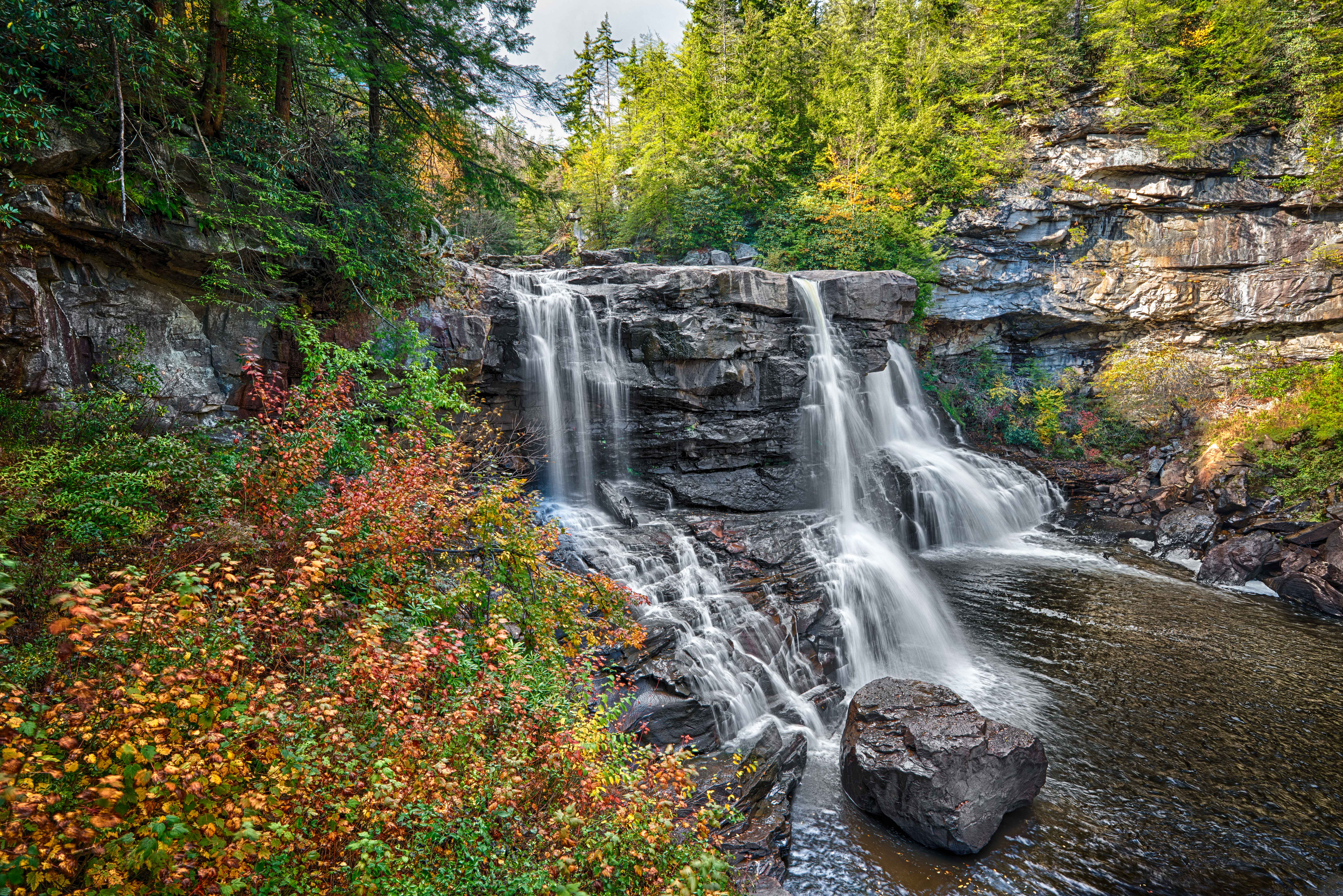
Another highlight of the trip was Blackwater Falls. The Blackwater River flows over the falls, dropping 62 feet. The flow over the falls was very light that day, as compared to when the river is raging. We may not have had a raging river, but we had fall colors surrounding the river and falls. Simply gorgeous.

I went to Blackwater Falls last year in the winter, when the falls were frozen. It was very challenging getting to them in the snow and ice, but it was worth it.

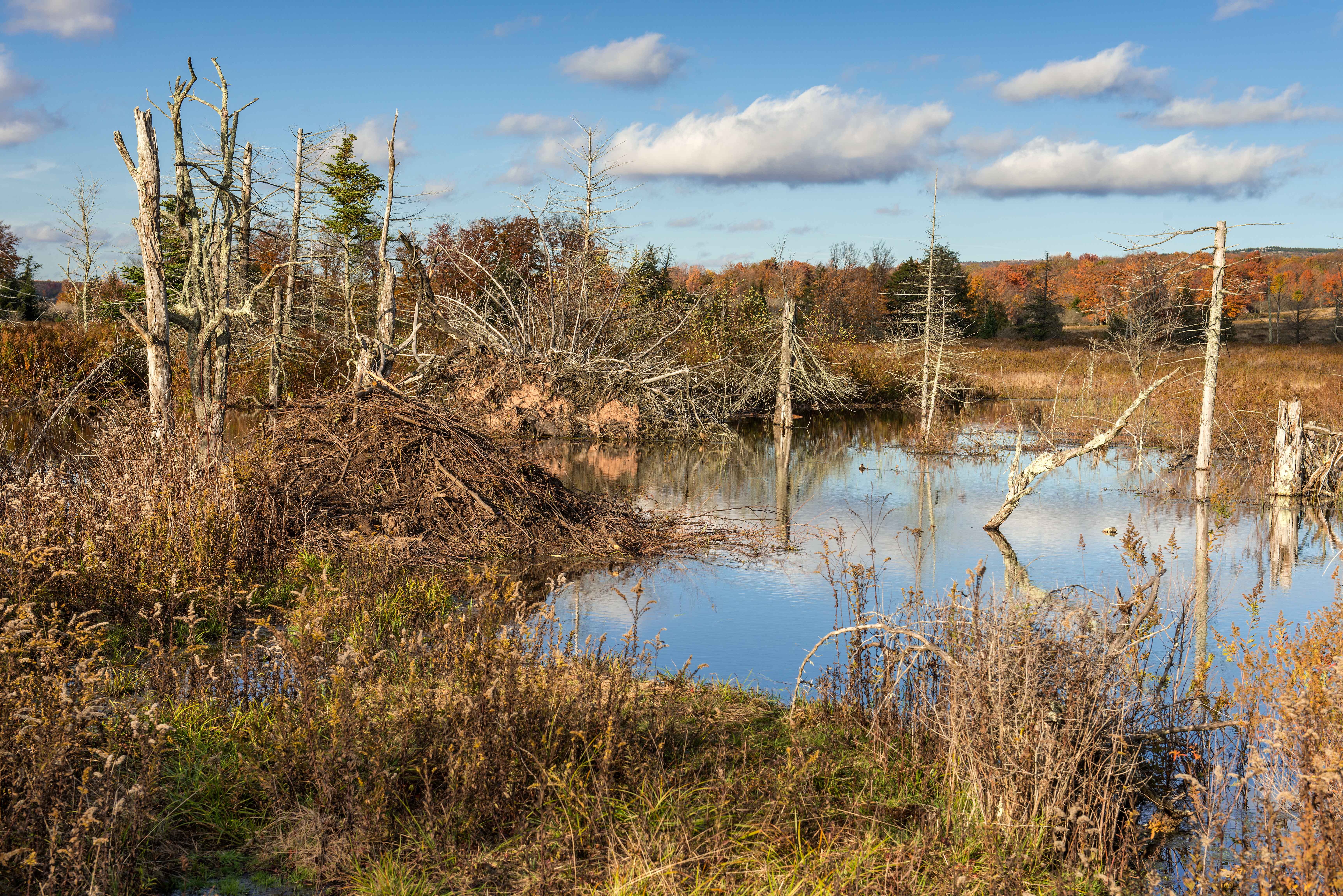
The final two images…for those of you still reading…were taken in Canaan Valley Wildlife Refuge in an area with wetlands and beavers. In the first image below, the beaver lodge, which was very large, is on the left. We did see an adult and young beaver, but we had just packed up our gear and were leaving, when they appeared. They knew that.

Above is the sun setting at the beaver pond, as we were leaving.

The above images and others can be seen on my website at: http://stabone.com/p754217942

I have been reviewing and processing my eagle images from last weekend. It was also a good trip and will be the subject of another blog article. If you would like to see those images, as well as others recently taken at Conowingo Dam, they can be seen at:  http://stabone.com/p922753828

All of the images in this article were taken with a Nikon D800 and predominantly with a Nikon 24-70mm lens.

Posted in Autumn Photography, National and State Parks, Nature, sunrise, Sunset | Tagged , , , , , , , , | 10 Comments

American Bald Eagles at Conowingo Dam

I have been slacking on my blogging! It has been nearly three weeks since I posted a new article to my blog. That is not because I have not been out enjoying nature and photographing what I experienced. Rather, it is because I have been out shooting but not processing my images, and also working at my consulting engagement. Something is going to have to give, and it is not photography! Actually, in about three weeks, I expect to be off for three months and have plans for many photography trips.

Two weeks ago, I picked up a friend (Ceasar Sharper), who is also a serious photographer, at 5:30 AM, and we drove about 115 miles to northern Maryland to Conowingo Dam on the Susquehanna River to photograph eagles. The dam is located about 9 miles from where the river empties into the Chesapeake Bay and 5 miles south of Pennsylvania. When construction of the dam was completed in 1928, it was the second largest hydroelectric project by power output in the United States, only behind Niagara Falls.

In the fall, and in particular in November, the dam is well known as a location to see American Bald Eagles, and it is not uncommon to see as many as 100 eagles feeding on fish in the Susquehanna River. The eagles and other birds congregate around the dam, because when the dam is opened to power the generators, the water flowing through the dam churns up fish for the waiting birds. Below you can see the hundreds of well-fed Cormorants, Blue Herons, and gulls at the base of the dam. If you click on the image and look closely, there is also a juvenile eagle sitting on the end of a concrete embankment.
It was my second visit to the dam, the first was after photographing sunflowers in early September. The farm where the sunflowers were located was within about 25 miles of the dam, and I wanted to check it out for future trips. When I was there in  September, I did not see any eagles, but two other photographers said they had photographed one earlier in the morning. My trip this Saturday was different. There were about a dozen eagles, several adults, but mostly juveniles.

Although there were about a dozen eagles, there was limited action during the day. The eagles only occasionally ventured from their perches high up in nearby power line towers.  The light was also not the best for photographing flying birds, since it was overcast most of the day and a high shutter speed is a necessity, which meant shooting at a high ISO. Nevertheless, I managed to capture some decent images. Below is an adult eagle at the moment after it broke the water with its talons to capture a fish. The image that follows is the same eagle as it lifted from the river with its catch.

The above image is my favorite of the day. Unfortunately, it was the only opportunity to photograph one of the eagles capturing a fish, and it happened soon after arriving at the dam. Click on the image to see it in detail and notice how it appears to be watching me as I photographed it. The following are some other images of adult eagles as they flew around the dam and river.

Besides adult American Bald Eagles, there were many juvenile eagles flying around the dam and river. Juvenile eagles are easily distinguishable from the adults because they do not have white heads and tails. It takes about five years for an eagle to attain white head and tail feathers. Below are images of a few of the juveniles.

Besides enjoying the sight of these majestic birds, across the river a group of terns occasionally took flight, when an eagle got too close. When the terns nervously flew about, their white bodies were brightly lit by the early morning sun.

Also making the day a great nature photography outing were the Cormorants that were catching fish (and an eel) in the river. Below are a few images of those activities.

The Cormorant worked the fish around until properly positioned for head-first swallowing.

As you can see from the above images, Ceasar and I had a great day at the dam. We are planning a trip next weekend, when we expect to see and photograph many more eagles. Recent reports from other photographers, who have been to the dam, confirm that many more eagles have arrived for their fall feast on shad and other fish.

Last weekend, I went to Canaan Valley, West Virginia, with a couple of friends and photographed the fall foliage, water falls at Blackwater Falls State Park, and sunrise and sunset on top of Dolly Sods, a rocky, high-altitude plateau with sweeping vistas at over 4,000 feet. I am working on those images, and they will be the subject of my next blog article. A “sneak preview” of a couple of those images can be seen at: http://stabone.com/p754217942

(Some of the images in this article were photographed with a Nikon D800, 600mm f4, and Nikon TC-14E II, and others with a Nikon D700, 70-200mm f2.8, and TC-20E III.)

Posted in Bird Photographs, Nature, Wildlife | Tagged , , , , | 12 Comments